The Role of Animal Symbolism in American Literature: A Guide for Humanities Students
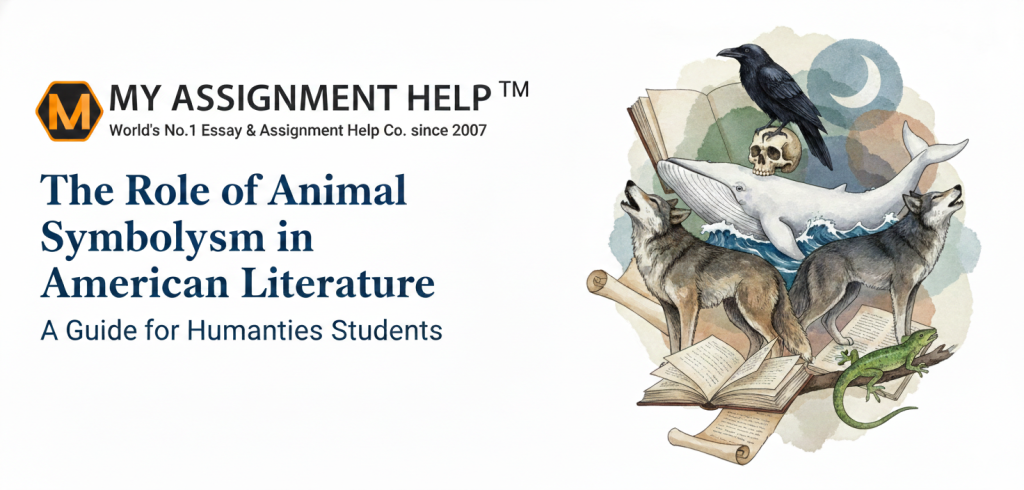
In the vast landscape of American literature, animals have rarely been mere background characters or simple biological entities. From the relentless pursuit of a great white whale to the haunting croak of a raven, animal symbolism serves as a foundational pillar upon which American authors build complex critiques of society, nature, and the human psyche. For humanities students, decoding these faunal signatures is not just an exercise in literary analysis—it is a gateway to understanding the evolution of the American identity.
The Wild Frontier: Nature as a Mirror of the Soul
In the early eras of American writing, particularly during the Romantic and Transcendentalist movements, animals represented the untamed essence of a new continent. For authors like Henry David Thoreau and Ralph Waldo Emerson, the animal kingdom was a manifestation of the “Over-Soul,” a way to connect with the divine. In Walden, Thoreau’s observation of a battle between red and black ants isn’t just about insects; it is a poignant commentary on the futility and heroism of human warfare.
As students delve deeper into these intricate metaphors, the sheer volume of analysis required can often feel overwhelming. Whether you are dissecting the theological implications of Moby Dick or the naturalistic despair in Jack London’s tales, the workload can escalate quickly. If you find yourself struggling to balance these complex readings with your academic deadlines, seeking professional coursework help can provide the structural support and expert insights needed to master your humanities curriculum. Engaging with expert resources allows you to move beyond surface-level summaries and engage in the high-level critical thinking that modern literary studies demand.
Icons of the American Canon: Case Studies in Symbolism
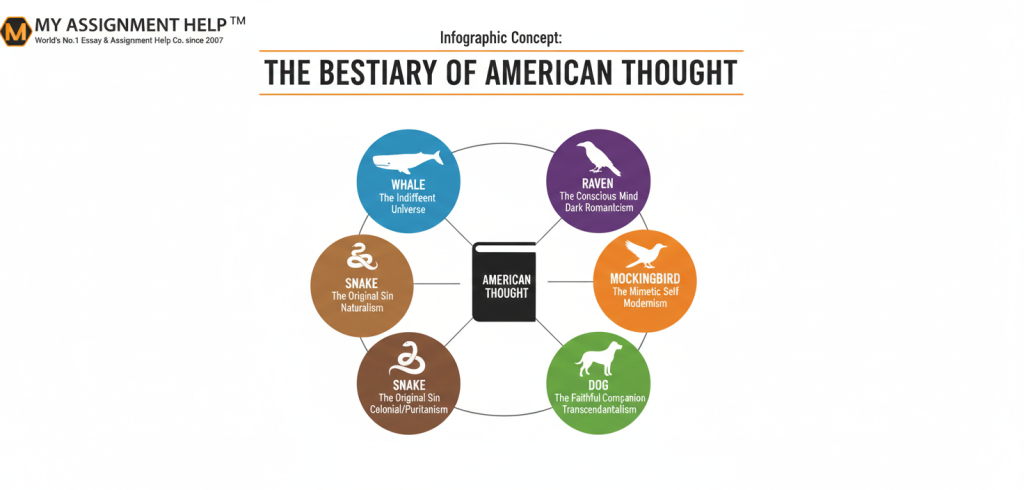
To truly understand animal symbolism, one must look at the specific creatures that have defined literary eras.
1. The Whale: Herman Melville’s Moby-Dick
Perhaps the most famous animal in all of literature, the White Whale is a “Rorschach test” for the characters of the Pequod. To Ahab, the whale is a personification of malice; to Starbuck, it is a source of oil and profit; to Ishmael, it is an inscrutable mystery of the sublime. Melville uses the whale to explore the limits of human knowledge and the indifference of the natural world.
2. The Raven: Edgar Allan Poe’s “The Raven”
In the realm of Gothic literature, Poe’s raven is a symbol of “mournful and never-ending remembrance.” Unlike the typical parrot that mimics for amusement, the raven’s repetition of “Nevermore” acts as a psychological mirror, reflecting the narrator’s descent into madness and his inability to escape the grief of his lost Lenore.
3. The Mockingbird: Harper Lee’s To Kill a Mockingbird
Moving into the 20th century, the animal becomes a moral compass. The mockingbird symbolizes innocence. As Miss Maudie explains, it is a sin to kill a mockingbird because they do nothing but make music for people to enjoy. Here, the animal represents the vulnerable members of society—Tom Robinson and Boo Radley—who are destroyed by the “predatory” nature of social prejudice.
Data-Driven Insights: Why Symbolism Matters
According to a 2023 survey of literary curricula in U.S. Liberal Arts colleges, approximately 74% of American Literature syllabi prioritize “Ecocriticism”—a branch of literary study that focuses on the relationship between humans and the environment. Data suggests that students who successfully identify and analyze non-human symbolism in their essays score 15-20% higher on critical thinking assessments compared to those who focus solely on plot-driven narratives.
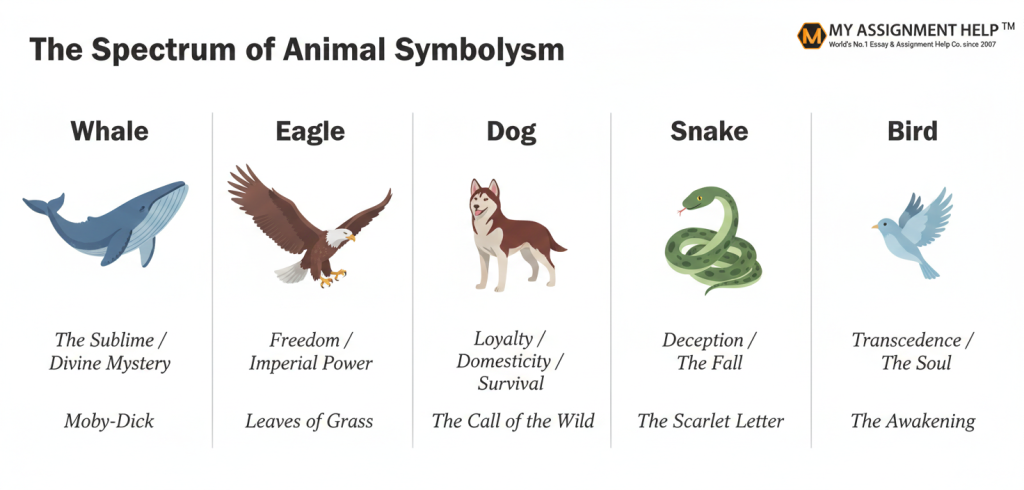
The Spectrum of Animal Symbolism
The Socio-Political Animal: Race and Identity
Humanities students must also recognize that animal symbolism is often weaponized or reclaimed in literature dealing with race. In African American literature, particularly in the works of Zora Neale Hurston or Ralph Ellison, “animalization” is often a critique of how Black Americans were viewed by a white-dominated society. Conversely, the “Brer Rabbit” folktales use a trickster animal to represent the survival and wit of the oppressed.
Key Takeaways for Students
- Look for Agency: Does the animal act on its own, or is it a passive recipient of human action? This distinguishes Naturalism from Romanticism.
- Context is King: A hawk in a poem by Robinson Jeffers means something very different than a hawk in a Native American oral tradition.
- Avoid Cliches: Don’t just say a “dove means peace.” Look at how the author twists that meaning within the specific American cultural landscape.
- Interdisciplinary Approach: Use history and sociology to understand why a certain animal was feared or revered during the time the book was written.
Conclusion
Animal symbolism in American literature is not a static list of definitions; it is a living, breathing language. By studying the creatures that inhabit our stories, humanities students gain a clearer view of the American psyche—our fears of the wild, our guilt over the past, and our enduring hope for transcendence.
FAQ Section
Q: What is the difference between an animal as a character and an animal as a symbol?
A: An animal character has its own motivations and dialogue (common in fables), whereas a symbolic animal primarily exists to represent a concept, such as “greed,” “innocence,” or “the unknown.”
Q: Why is Moby Dick white?
A: White is traditionally a symbol of purity, but Melville uses it to represent a terrifying “void” or an “absence of meaning,” challenging the reader’s expectations of color symbolism.
Q: How do I start analyzing an animal in a text?
A: Start by noting the animal’s physical traits and how the human characters react to it. Is it feared, worshipped, or ignored? These reactions usually point toward the symbolic meaning.
Author Bio
Dr. Sarah Jenkins is a Senior Academic Consultant at MyAssignmentHelp. With a Ph.D. in American Literature from the University of Chicago, Dr. Jenkins has spent over 12 years helping humanities students navigate the complexities of literary theory and coursework. Her research focuses on the intersection of 19th-century American prose and environmental ethics.
References
- Melville, H. (1851). Moby-Dick; or, The Whale. Harper & Brothers.
- Buell, L. (1995). The Environmental Imagination: Thoreau, Nature Writing, and the Formation of American Culture. Harvard University Press.
- Lee, H. (1960). To Kill a Mockingbird. J.B. Lippincott & Co.
- Kolodny, A. (1975). The Lay of the Land: Metaphor as Experience and History in American Life and Letters. University of North Carolina Press.
